


You may not spend a lot of time thinking about pallets but the truth is that they play a vital role in trade and commerce across the globe. Pallets protect products as they’re transported across oceans, roads, and land. They also protect goods when they’re stored at warehouses and distribution centers.
Having a basic understanding of the anatomy of a pallet is important for your bottom line and the health of your business. Here’s why. Pallet components can impact everything from product integrity and efficiency to costs and safety. Building your knowledge of pallets and how they’re constructed ultimately can help you reduce and optimize your shipping costs while better protecting the products your company is handling.
In this blog, we outline the basic anatomy of a pallet, highlighting the most common pallet components and their functions. We examine the differences between stringer and block pallets, two-way versus four-way entry pallets, and standard pallet weight capacities and sizes. We also tackle the different use cases for pallets, skids, and crates.
Read on to learn more about pallet components, skids and crates, and how you can use this knowledge to optimize and reduce your shipping costs.
The Basic Anatomy of a Pallet: Pallet Components
Most pallets are made of the same essential components, which we outline here:
The deck boards of a pallet are the top and bottom boards on which the products you’re shipping or storing rest. These flat, horizontal boards provide support for loads and often are nailed across stringers. Most standard pallets include seven top boards and five bottom boards.
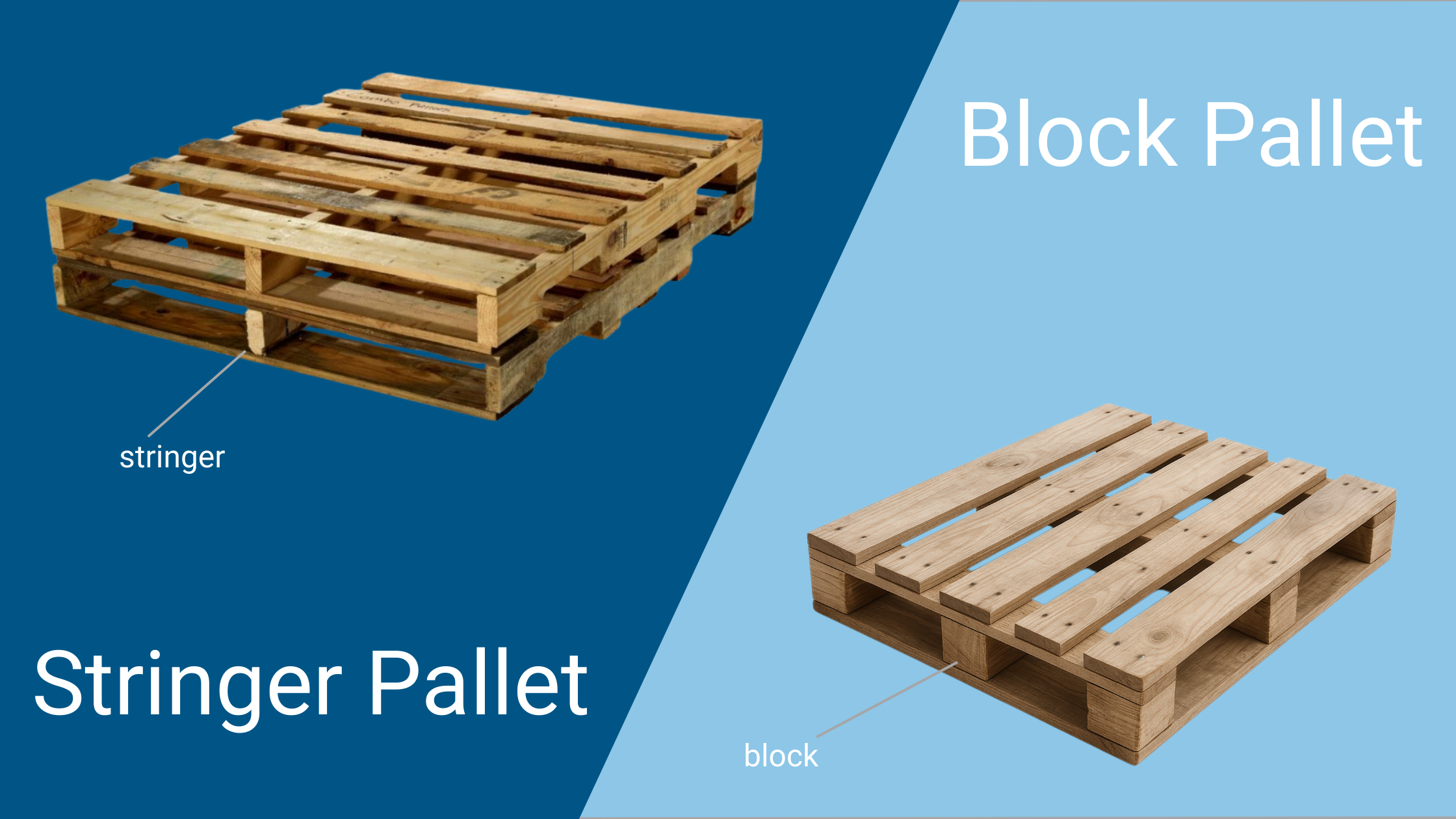
Next on our list of essential pallet components are stringers, the support beams that run perpendicular to deck boards in stringer pallets. Stringers create space between the top and bottom deck boards that allows forklifts and pallet jacks to lift and move pallets. Most stringer pallets are built with three parallel stringers to support the top and bottom deck boards.
Blocks are the support structures used in block pallet construction. Unlike stringer pallets, block pallets use nine blocks of solid wood to support the products being stored or moved on the pallet. These blocks are nailed or fastened to each of the four corners, to the center on each side of the pallet, and to the center of the pallet.
Notches are the openings in solid stringers that allow pallet jacks and forklifts to easily move pallets. A notch is a type of opening cut made into stringers to facilitate the use of fork lifts and pallet jacks.
The outer deck boards on the top and bottom of the pallet are called lead boards. Lead boards provide load protection and stability, which is ideal when pallets will be stacked or used with automation.
While most pallets are constructed with these same basic pallet components, pallets are available in a number of different types and sizes to meet various load and handling requirements. As mentioned above, pallets can be constructed as stringer pallets or block pallets. Stringer pallets are the most commonly used type of pallet in North America because they are light, affordable, and easy to use with forklifts. Block pallets often are preferred for heavy or oversized loads and/or when four-way access to the pallet is required.
Most pallets are specifically designed for use with fork lifts and pallet jacks. You typically can opt to buy pallets designed for two-way entry or four-way entry. With two-way entry pallets, a fork lift or pallet jack can enter and move the pallet only from two opposite sides. Four-way entry pallets are designed so that forklifts and pallet jacks can enter and move the pallet from any of its four sides.
Pallets are available in a wide variety of sizes. In North America, the most common sized pallet in use today measures 48 inches by 40 inches. This sized pallet is the standard for general warehousing and storage, grocery, and retail use in the United States. Keep in mind that the standard pallet sizes in other countries and regions may differ from U.S. pallet sizes and standards. For example, the standard pallet size in Europe is 1200 mm by 800 mm (47.2 inches by 31.5 inches).
Pallets are available in a variety of materials, as well. Pallets can be constructed using wood, plastic, metal, or composite. Most of the pallets used in North America are wood pallets. Plastic pallets offer a reusable and hygienic alternative to wood, while metal pallets can provide the strength needed for heavy-duty applications. Composite wood, which is made from recycled wood fibers and resins, is another increasingly popular option when it comes to pallet components and construction. Note: Wood pallets used for international shipping must comply with ISPM-15 heat-treatment standards to prevent the spread of pests.
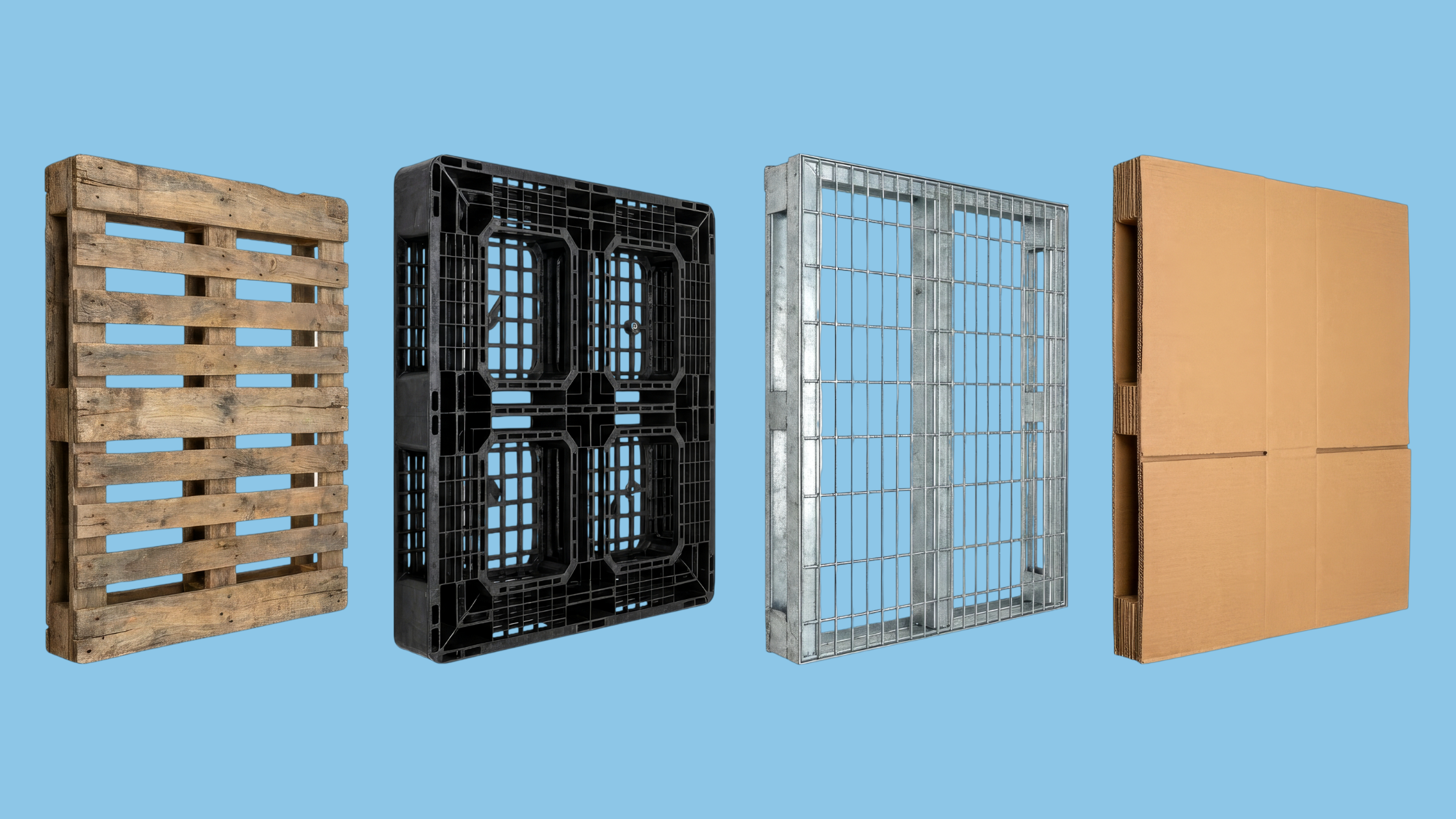
Another consideration in building your knowledge of pallet components and the anatomy of a pallet is weight capacity. Standard wood pallets typically can hold between 1,500 and 3,000 pounds, while the weight capacity for plastic pallets is 2,500+ pounds. Looking to move or store heavy duty products? Consider using metal pallets, which can support 8,000 pounds or more.
Something to keep in mind is that pallet weight/load capacity varies based on how the pallet is used. Static load refers to weight held while stationary, dynamic load applies when pallets are moved by forklifts or pallet jacks, and racking load reflects capacity when pallets are stored in rack systems.
What Is a Skid?
Skids have been used since the 1930s. Unlike a pallet, a skid is constructed with a single-deck platform and no bottom deck. Skids typically feature four feet or blocks underneath the top loading deck. Because there is no bottom deck on a skid, skids are typically cheaper than pallets. Skids, also known as nestable pallets or sleds, are designed to be dragged around–rather than stacked or racked–and are often used to store and support heavy equipment and machinery or oversized items.
Skids can easily be hauled or dragged, even across uneven terrain such as sand. They take up less space than pallets and can be stored in a nested fashion to take up even less space. Skids also may be used as a permanent foundation for long-term storage of heavy equipment. Skids often are used for products such as robotics, drivetrains, engines, landscaping and agricultural materials, and other items that are heavy, bulky, or irregularly shaped. Because they are designed to be dragged or moved, skids are less stable than pallets. Skids also are not ideal for stacking and/or complex forklifting handling.
What Is a Crate?
In contrast with pallets and skids, crates are enclosed shipping containers that include sides and often a top. Crates function as heavy-duty boxes that provide stability and security, shielding goods from dust, stacking pressure, moisture, shocks, vibrations, theft, and environmental factors. Crates are usually made of wood, plastic, or metal and are designed to provide maximum protection for high-value, fragile, heavy, and/or large products and items. Crates offer the highest level of security and protection because of their design but also because they can be locked or sealed to prevent tampering and theft. Products such as artwork, electronics, large machinery, automotive parts, and industrial equipment often are shipped or stored in crates.
Open crates are designed with an open door or no cover. Open crates offer excellent ventilation and are cost-effective and lightweight. However, open crates won’t protect your product(s) from rain, dust, or theft. Open crates are ideal for use with products that require ventilation, agricultural products, hay and cotton, and products that require K-9 inspection. Closed crates include a cover or top. Closed crates provide protection from the elements and maximum security against damage and theft but tend to be more expensive and take longer to ship. Fragile goods, art, electronics, sensitive equipment, hazardous materials, and exports often are shipped and stored using closed crates.
Quick Reference: Pallet vs Skid vs Crate
Check out this quick reference guide highlighting the differences between and use cases for pallets, skids, and crates.
|
Pallet |
Skid |
Crate |
|
|
Structure, design |
Deck boards, stringers or blocks, lead boards |
Single deck platform, blocks or feet |
Bottom, top, sides |
|
Forklift-ready |
Yes |
No |
Yes |
|
Cost |
Low to medium |
Low |
High |
|
Load protection |
Medium to high |
Low |
High |
|
Reuseable? |
Yes |
Yes |
Yes |
|
Durability |
Medium to high |
Low |
High |
|
Use cases |
Agricultural pharmaceutical retail manufacturing general goods |
Robotics drivetrains engines landscaping & agricultural storage heavy, bulky, or irregular |
Fragile goods artwork electronics large machinery automotive parts industrial equipment |
Key Takeaways: Understanding Pallet Components, Skids, and Crates
Check out these key takeaways from our discussion above of pallet components and the differences between pallets, skids, and crates:
- Pallets have both top and bottom decks with multiple entry points for handling equipment.
- Skids are simpler, single-deck platforms best for one-way shipping or lighter loads.
- Crates provide enclosed protection for valuable or fragile items.
- Understanding these differences can help you optimize shipping costs and boost product protection.
Request a consultation for custom crate and pallet solutions.