


Most companies know what they spend on pallets. Far fewer know what their pallet program actually costs them. There’s a difference. The purchase price of a pallet is easy to see. The costs created by inconsistent specifications, excess inventory, emergency orders, fragmented suppliers, poor recovery programs and pallets leaving a facility with value still in them are much harder to find. Individually, none of these may look significant. Across multiple facilities and hundreds of thousands of pallets, they can add up quickly.And you don't necessarily need to replace your suppliers to find the opportunity. You need to understand what's actually happening across the entire pallet program.
That means looking beyond what you're paying per pallet and understanding how pallets are being purchased, inventoried, used, recovered and managed from one facility to the next.
Start With the Pallet, Not the Price
When companies look for savings in pallet procurement, the natural place to start is price.What are we paying today? What can another supplier charge? Can we negotiate another 25 or 50 cents out of the pallet? Those are reasonable questions. They're just not the only questions. Before trying to lower the price, I'd want to know:
Questions to ask about your pallet program
- ✔ Are you buying the right pallet?
- ✔ Are facilities buying the same specification differently?
- ✔ Are you buying a higher grade than the operation actually requires?
- ✔ Are different locations paying materially different prices for essentially the same pallet?
- ✔ How much inventory is sitting at each facility?
- ✔ How often are emergency orders occurring?
- ✔ What happens to the pallets coming back into the facility?
- ✔ What gets reused, repaired, sold and recycled?
Those questions can uncover opportunities that another round of price negotiations won't.
A 50-cent reduction on a pallet gets everyone's attention because it's easy to calculate. Multiply it by annual volume and you have a savings number.
But what if you're buying pallets you don't need? What if one facility is carrying three weeks of inventory when another carries five days? What if you're buying a higher grade than the operation requires? What if pallets with recoverable value are leaving through the back door as scrap?
Those costs aren't as easy to put into a sourcing spreadsheet, but they're still costs.
What Happens at the Facility Matters
One thing I've learned working with multi-location companies is that the pallet program on a spreadsheet and the pallet program operating inside a distribution center aren't always the same thing. Procurement may have negotiated a national program. Operations still has to live with it. A facility may carry additional inventory because it doesn't trust the supplier to respond quickly enough. Another location may have modified a specification years ago to solve an operational problem that no longer exists. One facility may carefully separate valuable cores while another mixes them into scrap.There are usually reasons these things happen.
That's why I don't believe you can completely understand a pallet program by looking at purchase history and pricing alone. Effective pallet inventory management requires understanding what's actually happening at the facility and how pallets move through the operation.
How many pallets are on the ground? How many days of supply does that represent? Why is that amount being carried? How quickly can the supplier respond when demand changes? What happens when the facility runs short?
Excess inventory can tie up cash and consume valuable space. Too little inventory can put the operation at risk. Emergency orders can create additional freight costs and force teams to accept whatever supply is available.
The right inventory level isn't going to be the same for every facility. The point is knowing why the inventory is there instead of allowing historical practices to become the default.
Too Many Specifications Create Hidden Complexity
Specification creep is another area worth examining.
Companies rarely decide intentionally that they want dozens of pallet specifications across their network. It happens gradually.
A customer requires something different. A piece of automation creates a new requirement. A facility solves a local problem. A supplier recommends a change. An old specification remains in the system long after the original reason for it disappears.
Eventually, nobody is quite sure why all of the variations exist.
Some of them may be completely necessary. Some may not be.
I've seen companies with facilities buying pallets that appear almost identical but have small differences in board thickness, spacing, lumber or grade. Sometimes there's a legitimate operational reason for the difference. Other times, it's simply how that location has always bought the pallet.
Every unnecessary specification can make sourcing, inventory, supplier coverage and pricing more complicated. It can also reduce the number of suppliers capable of servicing the business and make it more difficult to move volume between suppliers or locations when conditions change.
Standardization isn't about forcing every operation onto the same pallet. It's about understanding where differences actually matter and where they don't.
If two facilities truly need different pallets, keep them different. If they don't, there may be an opportunity to simplify the program.
Supplier Strategy Matters Too
The same thinking applies to suppliers.
Having more suppliers doesn't automatically create more competition or reduce risk. Having fewer suppliers doesn't automatically make a program easier to manage.
What matters is whether the supplier structure matches what the business actually needs.
A supplier may perform extremely well in one market and struggle in another. A national agreement doesn't change local access to lumber, recycled pallet cores, transportation or labor. Pallet markets are regional, and supply conditions can change.
That becomes especially important when demand increases or supply tightens.
A company that has optimized everything around one source may have a great price when the market is stable. The real test comes when volume changes, cores become harder to find, transportation costs move or a supplier has to make decisions about which customers it can continue servicing.
A good supplier strategy should account for price and performance, but also coverage, capacity and alternatives when conditions change.
The goal isn't to replace good suppliers. It's to know where you're exposed before that exposure becomes an operational problem.
The Cheapest Pallet Isn't Always the Lowest-Cost Pallet
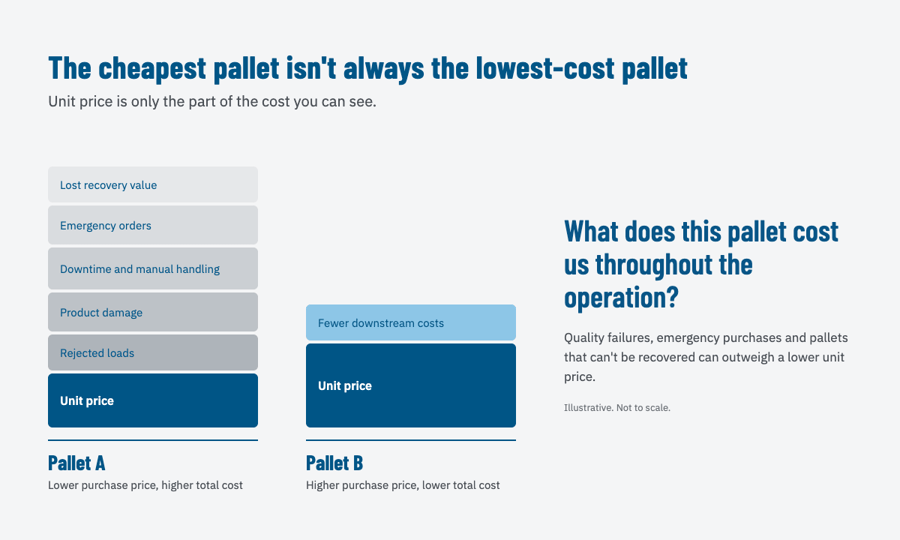
A lower unit price looks good on a sourcing report. It doesn't look as good when the pallet creates problems downstream.
Quality failures can cause rejected loads, damaged product, manual handling and downtime. Poor supplier performance can lead to emergency purchases. An inexpensive pallet that cannot be recovered or reused may ultimately cost more than an alternative with a higher purchase price.
The pallet also has to work with the operation around it.
A small change that doesn't seem significant on paper can matter when that pallet reaches a conveyor, palletizer, rack or automated system. What looks like a purchasing decision can quickly become an operations problem.
That doesn't mean price isn't important. It means price needs context.
What does this pallet cost us throughout the operation?
That's a harder question to answer, but it's usually a more valuable one.
A good pallet program should be able to look at the purchase price alongside quality, service, inventory, operational performance and what happens to the pallet after it's used.
Otherwise, you may be optimizing one line item while creating costs somewhere else.
What Happens to the Pallet After Use?
The other side of the equation gets even less attention.
Companies spend a lot of time managing what they pay for pallets and surprisingly little time understanding what happens to them afterward.
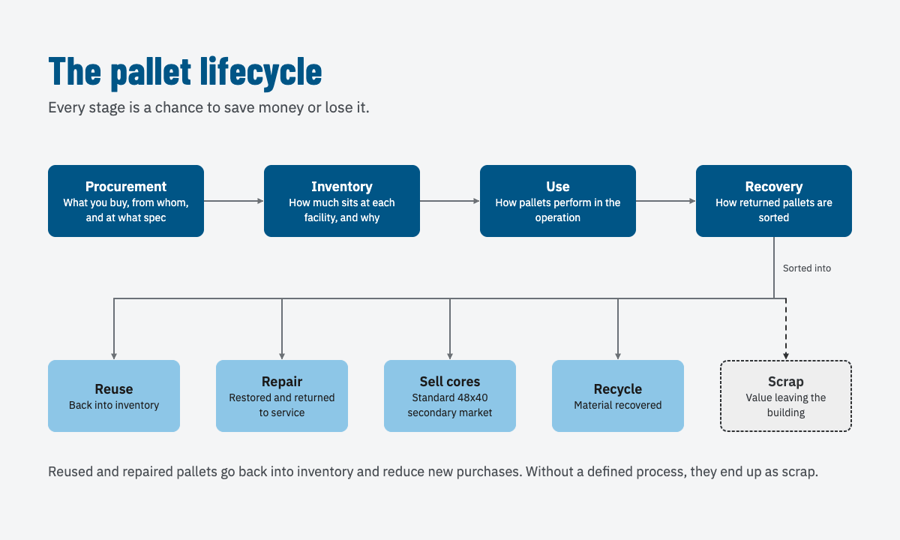
Good pallets may be reused internally. Repairable pallets may still have value. Standard 48x40 cores may have a secondary market. Other pallets may need to be recycled.
But without a defined process, valuable material can end up mixed together, hauled away or treated as scrap.
That's money leaving the building.
And just like purchasing, recovery practices can vary significantly between locations. One facility may have a well-managed process for sorting and recovering pallets while another facility within the same company handles essentially the same material completely differently.
A good recovery program should make it clear what is being generated, how it's being sorted, where it's going and what value is being recovered.
It should also give the company visibility across facilities. If one location is generating significantly more scrap, receiving less value for reusable pallets or handling material differently, there should be a way to see it and understand why.
Buying better is only half of pallet management. Recovering value matters too.
Look at the Entire Program
The biggest opportunities I've seen in pallet management aren't always created by replacing an incumbent supplier or running another bid.
Sometimes the existing supplier is doing a good job.
The opportunity is elsewhere.
It may be in the specification. It may be inventory. It may be inconsistent practices between facilities. It may be supplier coverage. It may be recovery. Or it may simply be a lack of visibility across the network.
That's why the first step shouldn't always be asking suppliers for a lower price. Sometimes the better first question is:
Where is the money going today?
Answering that means looking at the entire pallet management program, not just the purchase order. Look closely enough at the full pallet lifecycle, from procurement and inventory through use, recovery and disposal, and you may find there's more money hiding in your pallet program than you think.
At PalletTrader, that's exactly what we're looking for.
Buy better. Waste less. Recover more.